
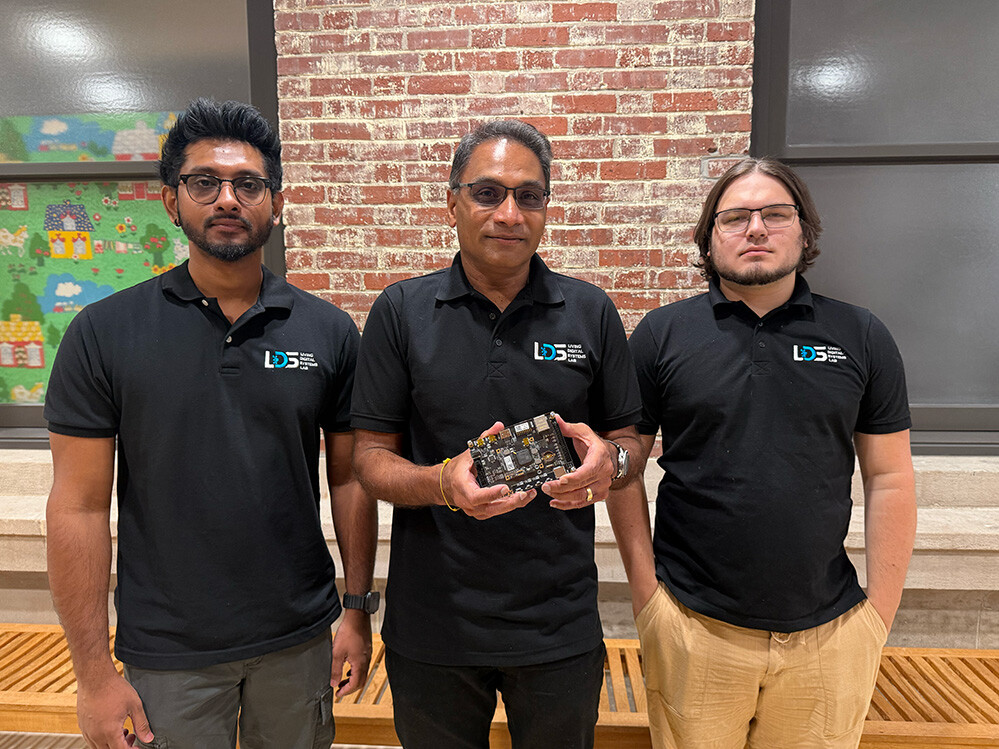
Balasubramaniam uses bacterial gene networks to develop new miniature AI architecture
Researchers at the University of Nebraska have developed a novel miniature AI architecture by leveraging bacterial gene networks.
The story
in brief.
What happened, who it affects, and why it landed on our intelligence desk — in plain English, sixty seconds or less.
Researchers at the University of Nebraska have developed a novel miniature AI architecture by leveraging bacterial gene networks. This interdisciplinary approach merges biological systems with computational design, creating efficient, small-scale artificial intelligence solutions. The study demonstrates how natural biological processes can inspire innovative engineering frameworks, potentially reducing hardware requirements for AI deployment. This development highlights the growing convergence of life sciences and technology, offering new computational models that mimic organic efficiency. Professionals should note this shift towards bio-inspired computing, which challenges traditional silicon-based approaches and suggests future advancements in compact, energy-efficient intelligent systems for diverse industrial applications.
Indicative index of skill mentions in professional job postings for the field this story moves (2019 = 1)
What this means
for your career.
Every headline redistributes opportunity. Here is who this one rewards — and how to be on the right side of it.
This breakthrough signals a pivotal shift towards bio-inspired computing, meaning your career trajectory should now account for interdisciplinary convergence. Traditional AI roles are evolving; pure software engineering is no longer sufficient. You must cultivate skills at the intersection of biology and computer science to remain competitive. Professionals in data science and engineering should immediately explore synthetic biology fundamentals. Do not ignore this trend, as it redefines hardware efficiency and algorithmic design. A smart professional would upskill in systems biology and neural network architecture. Start reading cross-disciplinary research papers and engage with communities bridging biotechnology and AI. This is not a niche interest but a foundational shift in how intelligence is engineered. Adapt now to lead in this emerging field, or risk obsolescence as bio-hybrid systems become the industry standard for next-generation computing.
For this story, the fields that convert it into pay are Artificial Intelligence, Data Science, Engineering and Innovation — exactly the programmes matched below. The chart shows the indicative salary uplift certified professionals report in each of those fields; every one of them is a click away, from £79, finishing in as few as 20 days.
Indicative ranges from published continuing-education salary studies, by field — each field is a recommended course below
Enrol in these
to benefit.
These programmes position you for exactly this shift — online, self-paced, and finishing with a verifiable certificate you can share the day you pass.
 Best match
Certificate in Artificial Intelligence
 Recommended
Certificate in Data Science
 Recommended
Certificate in Engineering
 Recommended
Certificate in Innovation
Launch pricing shown against standard certificate value. The fee you see today is the fee you lock in.
This briefing is based on reporting by Nebraska Today on 21 Sep, 05:33. Read the original coverage →
Read the news. Then outrun it.
Every OnlineUni programme is online, self-paced and from £79 — so a headline today can be your credential this month.