
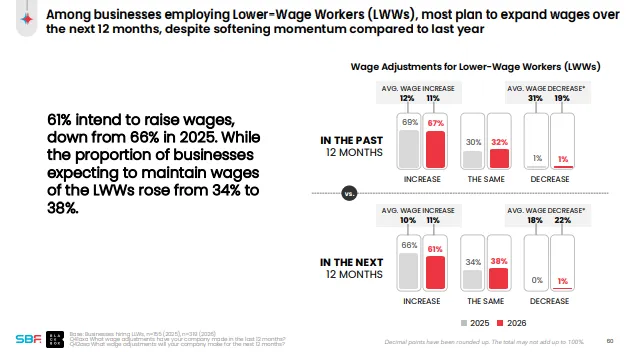
Firms raising low-wage pay drops to 67% YoY: survey
A recent survey indicates that the proportion of firms raising low-wage salaries has fallen to sixty-seven per cent year-on-year.
The story
in brief.
What happened, who it affects, and why it landed on our intelligence desk — in plain English, sixty seconds or less.
A recent survey indicates that the proportion of firms raising low-wage salaries has fallen to sixty-seven per cent year-on-year. This significant decline suggests a tightening labour market for entry-level and lower-skilled roles. Organisations are increasingly hesitant to increase base pay for these positions, reflecting broader economic pressures or shifting compensation strategies. Professionals in these sectors may face stagnation in earnings growth. This data point highlights a structural change in how companies value foundational labour. Understanding this trend is crucial for career planning, as it signals potential challenges in negotiating raises or securing competitive starting salaries in the near future.
Indicative index of skill mentions in professional job postings for the field this story moves (2019 = 1)
What this means
for your career.
Every headline redistributes opportunity. Here is who this one rewards — and how to be on the right side of it.
You must adapt your career strategy immediately. Traditional low-wage roles offer diminishing financial returns, so you should pivot towards skills that drive efficiency and measurable value. Upskilling in data literacy or process optimisation makes you indispensable, as firms seek to maximise output without increasing headcount costs. Focus on roles that leverage technology to streamline operations. You should also strengthen your negotiation tactics by demonstrating direct ROI rather than relying on standard salary benchmarks. Consider specialising in niche areas where supply is low. Proactively seek cross-functional projects to broaden your experience. By positioning yourself as a solution to cost pressures rather than a cost centre, you secure better prospects. Prioritise continuous learning in high-demand technical fields to future-proof your income against this downward trend in wage growth for junior positions.
For this story, the fields that convert it into pay are Data Science, Project Management, Business And Management and People Analytics Strategy — exactly the programmes matched below. The chart shows the indicative salary uplift certified professionals report in each of those fields; every one of them is a click away, from £79, finishing in as few as 20 days.
Indicative ranges from published continuing-education salary studies, by field — each field is a recommended course below
Enrol in these
to benefit.
These programmes position you for exactly this shift — online, self-paced, and finishing with a verifiable certificate you can share the day you pass.
 Best match
Certificate in Data Science
Recommended
Certificate in Project Management
 Recommended
Certificate in Business And Management
 Recommended
Certificate in People Analytics Strategy
Launch pricing shown against standard certificate value. The fee you see today is the fee you lock in.
This briefing is based on reporting by Singapore Business Review on 23 Sep, 21:00. Read the original coverage →
Read the news. Then outrun it.
Every OnlineUni programme is online, self-paced and from £79 — so a headline today can be your credential this month.