
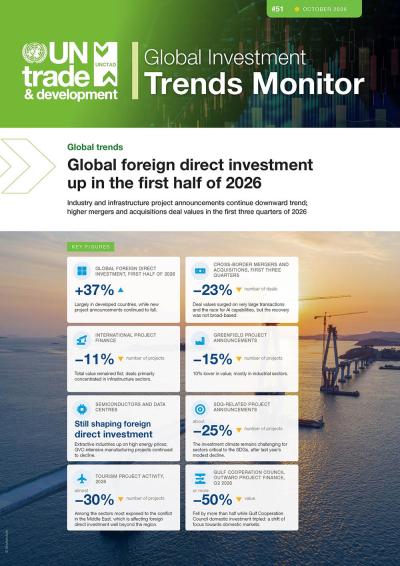
Global Investment Trends Monitor, No. 51
The latest Global Investment Trends Monitor from UNCTAD provides a comprehensive overview of international direct investment flows and emerging patterns.
The story
in brief.
What happened, who it affects, and why it landed on our intelligence desk — in plain English, sixty seconds or less.
The latest Global Investment Trends Monitor from UNCTAD provides a comprehensive overview of international direct investment flows and emerging patterns. It highlights shifts in capital allocation across key sectors and regions, reflecting broader economic dynamics. The report details changes in investment volumes, host country preferences, and sectoral distributions. Professionals can use this data to understand where global capital is currently directed, identifying both resilient markets and those facing contraction. This factual summary serves as a baseline for strategic decision-making, offering clarity on the current state of global investment without speculative commentary.
Indicative index of skill mentions in professional job postings for the field this story moves (2019 = 1)
What this means
for your career.
Every headline redistributes opportunity. Here is who this one rewards — and how to be on the right side of it.
You must align your career strategy with where global capital is actually flowing. If investment concentrates in technology or sustainable infrastructure, technical and regulatory expertise becomes highly valuable. Identify which sectors in your region are attracting or losing funds. Adapt your skill set accordingly; if traditional industries decline, pivot towards growth areas like green energy or digital services. Engage with your network to discuss these trends, ensuring your professional brand reflects current market demands. Proactively seek roles in high-growth sectors identified in the report. Ignoring these shifts risks professional stagnation. Instead, leverage this data to negotiate better positions, upskill in relevant areas, and position yourself as a forward-thinking asset within your organisation. Stay agile and informed.
For this story, the fields that convert it into pay are Finance and Accounting, Risk Management Strategies, Sustainability management and Business And Management — exactly the programmes matched below. The chart shows the indicative salary uplift certified professionals report in each of those fields; every one of them is a click away, from £79, finishing in as few as 20 days.
Indicative ranges from published continuing-education salary studies, by field — each field is a recommended course below
Enrol in these
to benefit.
These programmes position you for exactly this shift — online, self-paced, and finishing with a verifiable certificate you can share the day you pass.
 Best match
Certificate in Finance and Accounting
 Recommended
Certificate in Risk Management Strategies
 Recommended
Certificate in Sustainability management
Recommended
Certificate in Business And Management
Launch pricing shown against standard certificate value. The fee you see today is the fee you lock in.
This briefing is based on reporting by UN Trade and Development (UNCTAD) on 25 Oct, 05:57. Read the original coverage →
Read the news. Then outrun it.
Every OnlineUni programme is online, self-paced and from £79 — so a headline today can be your credential this month.