
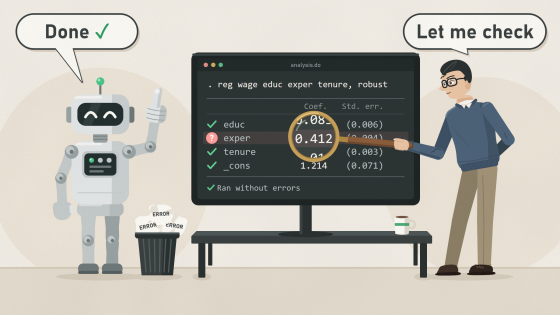
Letting AI agents write econometric code
Recent analysis from the Centre for Economic Policy Research examines the emerging practice of employing artificial intelligence agents to generate econometric code.
The story
in brief.
What happened, who it affects, and why it landed on our intelligence desk — in plain English, sixty seconds or less.
Recent analysis from the Centre for Economic Policy Research examines the emerging practice of employing artificial intelligence agents to generate econometric code. The report highlights how automated tools are increasingly capable of handling complex statistical programming tasks traditionally performed by economists and data analysts. This shift challenges conventional workflows, suggesting that routine coding duties may soon be largely automated. The piece provides a neutral overview of current capabilities, focusing on the technical feasibility and potential efficiency gains within economic research and financial modelling sectors.
Indicative index of skill mentions in professional job postings for the field this story moves (2019 = 1)
What this means
for your career.
Every headline redistributes opportunity. Here is who this one rewards — and how to be on the right side of it.
This shift demands immediate attention from economists, data analysts, and quantitative researchers. Your value no longer lies in writing syntax but in framing precise economic questions and validating algorithmic outputs. Skills in critical evaluation and domain expertise will rise sharply in value, while basic coding proficiency becomes secondary. You must pivot from being a coder to a strategic overseer of AI systems. Prioritise understanding the theoretical underpinnings of econometrics to spot hallucinations or logical errors in generated code. Invest time in learning how to prompt effectively and integrate AI tools into your existing workflow. Professionals who adapt will leverage speed; those who ignore this trend risk obsolescence as automation handles the technical heavy lifting of data analysis.
For this story, the fields that convert it into pay are Artificial Intelligence, Data Science, Financial Modeling and Python For Data Analysis — exactly the programmes matched below. The chart shows the indicative salary uplift certified professionals report in each of those fields; every one of them is a click away, from £79, finishing in as few as 20 days.
Indicative ranges from published continuing-education salary studies, by field — each field is a recommended course below
Enrol in these
to benefit.
These programmes position you for exactly this shift — online, self-paced, and finishing with a verifiable certificate you can share the day you pass.
 Best match
Certificate in Artificial Intelligence
 Recommended
Certificate in Data Science
 Recommended
Certificate in Financial Modeling
 Recommended
Certificate in Python For Data Analysis
Launch pricing shown against standard certificate value. The fee you see today is the fee you lock in.
This briefing is based on reporting by CEPR on 17 Oct, 23:09. Read the original coverage →
Read the news. Then outrun it.
Every OnlineUni programme is online, self-paced and from £79 — so a headline today can be your credential this month.